




Strategic Partnerships Driving Sustainable Humanitarian Packaging: NRS Relief at the 2nd Sustainability Symposium


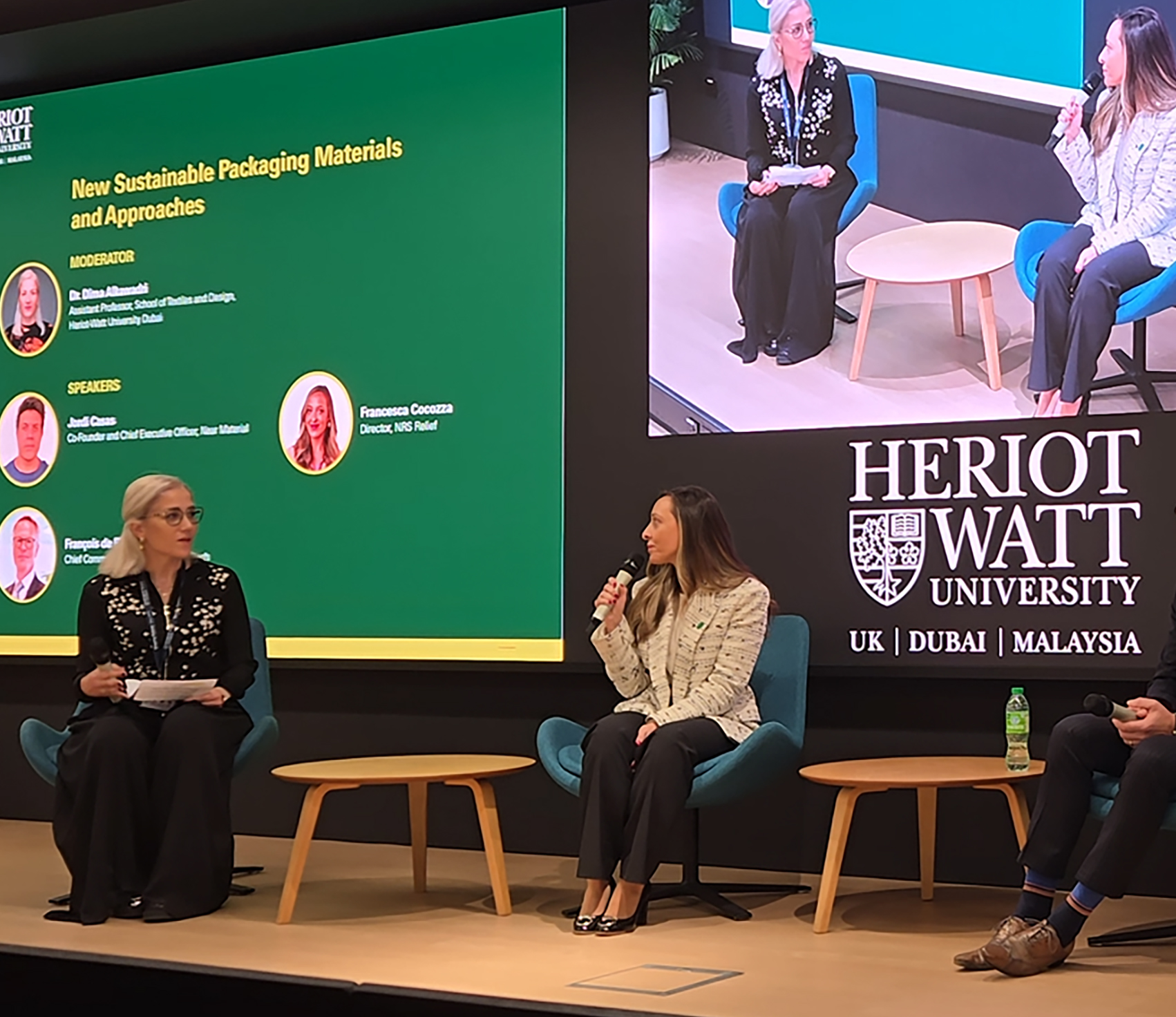
For the second consecutive year, NRS Relief was proud to participate in the Sustainability Symposium hosted by the Scientific Platform at Heriot-Watt University Dubai, contributing to enriching the discussion on the importance of developing and adopting sustainable packaging solutions.
In January 2026, our Director, Francesca Cocozza, participated as a panellist at the 2nd Sustainability Symposium hosted by Heriot-Watt University Dubai. Titled “The Essential Role of Strategic Partnership in Achieving Sustainable Packaging Solutions”, the symposium convened industry leaders, innovators, academics, and humanitarian actors to explore practical pathways toward more responsible materials and circular systems. Francesca joined the panel discussion “New Sustainable Packaging Materials and Approaches”, alongside experts in design, biotechnology, and advanced materials. The discussion moved beyond simple material substitution. Instead of asking, “What can replace plastic?”, the conversation examined system-level transformation, where innovation, cross-sector collaboration, supply chain accountability, and measurable impact drive real change.
Sustainability in humanitarian action is no longer optional; it is operationally essential. As climate change intensifies disasters and supply chains grow more complex, the humanitarian sector must rethink how relief items are designed, packaged, transported, and disposed of. Sustainable packaging is emerging as a critical lever in reducing environmental impact while strengthening long-term resilience.
NRS Relief is a member of the Scientific Platform of Sustainable Packaging, led by Heriot-Watt University — a multidisciplinary network of more than 20 experts collaborating to advance research-driven, scalable sustainable packaging solutions.
For the humanitarian sector, this shift is critical. Packaging decisions affect carbon emissions, transport efficiency, waste management in fragile contexts, and the long-term environmental footprint of emergency response. Sustainable humanitarian logistics must therefore consider recyclability, durability, local waste infrastructure, and circular economy models from the outset.
At NRS Relief, sustainability is embedded in how we design, manufacture, and deliver humanitarian solutions. From reducing single-use plastics and increasing recycled content, to improving recyclability and advancing circular design principles, we recognise that responsible production directly strengthens humanitarian impact. Strategic partnerships remain central to accelerating this progress, particularly when operating in climate-vulnerable and crisis-affected regions.
Our participation in the 2nd Sustainability Symposium builds on a long-standing partnership with Heriot-Watt University Dubai.
In October 2024, NRS Relief became a strategic sponsor of the Packaging for Sustainability Programme, delivered in collaboration with Heriot-Watt University Dubai and Dubai Humanitarian. The initiative advances sustainable packaging within humanitarian supply chains by promoting responsible materials, reducing post-consumption waste, and strengthening circular systems.
The 2024 winning student team presented their solutions at COP29, demonstrating how academic innovation can contribute to global climate action and more sustainable humanitarian operations.
As the humanitarian sector adapts to increasing climate pressures, partnerships like the one between NRS Relief and Heriot-Watt University Dubai demonstrate that sustainable transformation is not achieved in isolation. It requires shared expertise, long-term commitment, and measurable action.
Sustainability in humanitarian operations is not a future ambition; it is a present responsibility.